Engineering Florida's Data Center Surge
The Ground Beneath the Cloud: Engineering South Florida's Data Center Surge
Miami is no longer just a real estate market. It is rapidly becoming a digital infrastructure market — and the civil engineering profession has not caught up. Hyperscale operators, co-location providers, and sovereign cloud deployments are converging on South Florida with unprecedented speed, drawn by the region's status as the subsea cable terminus for Latin America, its growing tech talent concentration, and its geographic position as the gateway between North and South American capital markets.
The demand is real. But the delivery risk is equally real — and it lives in the civil and structural engineering layers that the industry too often treats as a commodity. At ASOM, we believe the firms that understand South Florida's subsurface, its power infrastructure fragility, and its regulatory environment will define who wins in this market over the next decade. The firms that don't will learn expensive lessons in schedule delays, flood damage, and permitting attrition.
The Cable Gravity Driving Everything
Miami's position as the subsea cable hub of the Americas is not an accident — it is a structural geographic advantage that has compounded over 30 years. Today, more than 28 subsea cable systems land in the Miami area, connecting the United States to Latin America, the Caribbean, Europe, and West Africa. For hyperscalers and co-location providers serving those markets, proximity to those cable landing stations is a hard latency requirement, not a preference.
This creates an anchor effect: the more cable infrastructure lands here, the more compute must follow. Every major cloud provider with Latin American ambitions — and every financial services firm operating across hemispheres — has a stake in keeping data close to these cable heads. That logic alone will sustain South Florida data center demand independent of broader economic cycles. The civil engineering implication is that this is not a speculative asset class — it is mission-critical infrastructure, and it must be engineered to that standard.
The Ground Does Not Cooperate
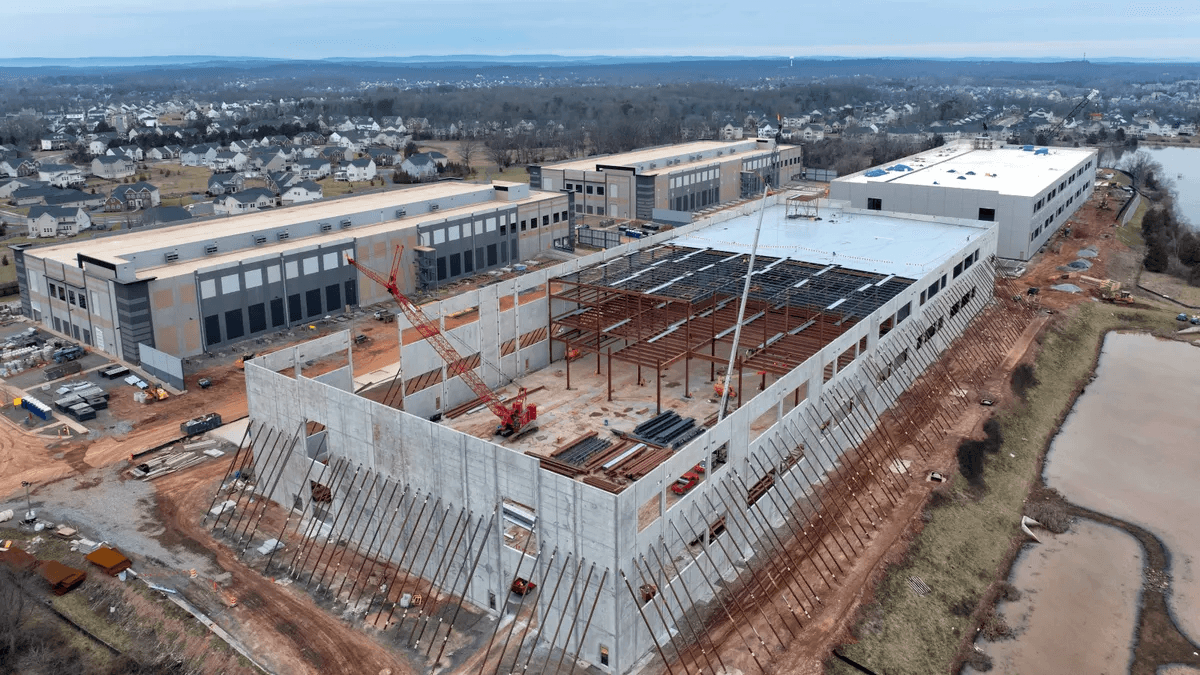
South Florida sits on the Miami Limestone and Fort Thompson formations — a highly porous, karst-influenced geology that is unlike anything in the major data center corridors of Northern Virginia, Dallas, or Phoenix. Data centers are extraordinarily heavy buildings: raised floor systems, dense battery infrastructure for UPS, diesel fuel storage, and generator pads each impose concentrated loads on a substrate that must be evaluated with far greater care than a standard industrial tilt-wall project.
The region's shallow water table — often just 4 to 8 feet below grade in Miami-Dade — compounds this challenge. Mechanical, electrical, and plumbing systems that are typically below-grade in other markets must be reconsidered here. Slab-on-grade designs with integrated vapor barriers, strategic site grading, and careful dewatering plans during construction are not optional engineering refinements in South Florida — they are baseline requirements that separate a functional campus from a chronic maintenance liability.
ASOM's site engineering work in this region consistently begins with detailed geotechnical investigations that go beyond standard boring logs. In a market this competitive, the difference between an 18-month delivery and a 26-month one often comes down to what the engineer discovered — or failed to discover — in that initial ground assessment.
Hurricane Resilience Hidden Cost
Data centers in South Florida must be engineered to Miami-Dade's High-Velocity Hurricane Zone (HVHZ) standards — the most stringent wind design requirements in the continental United States. This is not a compliance checkbox. It is a fundamental determinant of the asset's insurability, its operational continuity value, and its long-term cost of capital.
The 2004 and 2005 hurricane seasons demonstrated what inadequate envelope design means for mission-critical facilities: not just physical damage, but catastrophic SLA failures, client departures, and reputational loss that outlasted the structural repairs by years. Since then, major operators have moved toward hardened concrete construction, impact-rated louver systems, and generator enclosures designed for sustained 185 mph wind events. The cost premium is real — roughly 12 to 18% over conventional construction — but so is the insurance and operational continuity dividend.
ASOM designs to the HVHZ standard as a baseline. More importantly, we model the whole-life cost of resilience investment against actuarial loss scenarios so our clients can present a quantified case to capital partners — not just a regulatory compliance narrative.
The Power Grid Bottleneck
A 100 MW hyperscale data center is not just a large building. It is a power substation with a building attached. The interconnection queue for new utility service in Miami-Dade and Broward counties has grown substantially as industrial and data center load has accelerated, and the civil infrastructure required to support dedicated substation construction — including access roads, grading, drainage, retaining structures, and coordination with Florida Power & Light on substation pads — represents a meaningful portion of total project cost and schedule.
Savvy developers are beginning to approach power availability as a site selection filter before they engage architects or structural engineers. ASOM works alongside power consultants and MEP engineers at the pre-development phase to evaluate grading and civil feasibility in parallel with utility interconnection timelines — because discovering a utility constraint after a land purchase is a significantly more expensive problem than discovering it before one.
Sea Level Rise Impact on Pro Forma Horizon
A data center built in South Florida in 2026 will be operational in 2056, 2066, and potentially beyond. NOAA's intermediate projections for Miami show between 2.5 and 4.5 feet of sea level rise by 2070. Miami-Dade County's own sea level rise projections, used for infrastructure planning, align with that range. At current low-lying industrial land elevations in Doral, Medley, Hialeah, and unincorporated western Miami-Dade, this is not a distant abstraction — it is a capital planning variable that affects flood insurance actuarials, FEMA flood zone designations, and long-term operational continuity.
ASOM's approach to data center civil design incorporates adaptive grading strategies: designing finished floor elevations that meet near-term regulatory requirements while incorporating passive resilience against rising flood base elevations. We also evaluate stormwater infrastructure at the campus level for 50-year design storms — not the minimum statutory requirement — because a facility designed only for today's standards will require expensive retroactive hardening at a time when the owner least wants to take a critical asset offline.
ASOM's Advantage
Building for the Cloud in One of the World's Most Demanding Environments
South Florida's data center boom is real, it is durable, and it is engineering-intensive in ways that generic industrial experience does not address. The region's geology, hydrology, wind regime, power infrastructure, and sea level trajectory each represent a distinct discipline that must be integrated at the civil and structural design layer — not managed in silos.
At American Services of Miami, we bring decade-level local expertise to every phase of data center development: from pre-acquisition site assessment and geotechnical risk evaluation, through full civil design, HVHZ-compliant structural coordination, stormwater permitting, and construction administration. We are the civil engineering partner for developers, owner-operators, and capital partners who understand that ground truth matters as much as market thesis.