How to Complete Miami's Ambitious Water and Sewer Capital Improvement Program
The Future of Miami's Water and Sewer Infrastructure
The Miami-Dade Water and Sewer Department serves 2.4 million residents across the largest water and sewer utility in the southeastern United States — and its infrastructure, much of it installed during the explosive suburban growth of the 1960s through 1980s, is aging into failure simultaneously with the region's most demanding period of population growth in its modern history. The response is a multi-decade, multi-billion dollar Capital Improvement Program that is, by any fair measure, one of the most complex civil infrastructure undertakings ever attempted in South Florida.
The headline numbers are striking: an estimated $24.9 billion in projected economic output, approximately 17,000 new jobs created over the first ten years, and a scope that encompasses treatment plant upgrades, thousands of miles of pipe rehabilitation, ocean outfall elimination, a federally mandated consent decree program, and a sweeping septic-to-sewer conversion affecting tens of thousands of residential properties. Those numbers reflect genuine ambition. What they do not reflect — at least not in the public-facing program narrative — is the compounding execution complexity that will determine whether that ambition becomes infrastructure reality or a protracted cycle of delays, cost overruns, and regulatory non-compliance.
Understanding the Program's Structural Architecture
Before engaging with the execution challenges, it is worth being precise about what this CIP actually requires, because its complexity is not a single program — it is five overlapping programs running simultaneously, each with its own regulatory driver, its own timeline pressure, and its own engineering discipline.
The Consent Decree program — $1.6 billion over fifteen years — is the non-negotiable floor. It exists because the federal government and the State of Florida reached a legal agreement with Miami-Dade County that the existing wastewater collection and treatment system was failing to meet regulatory standards. Sanitary sewer overflows, capacity violations, and effluent quality deficiencies were not episodic events — they were systemic conditions. A consent decree is not a grant or a preference. It is a court-enforceable obligation with financial penalties for non-performance. Every project manager and every contractor operating within this program works in the shadow of that legal reality.
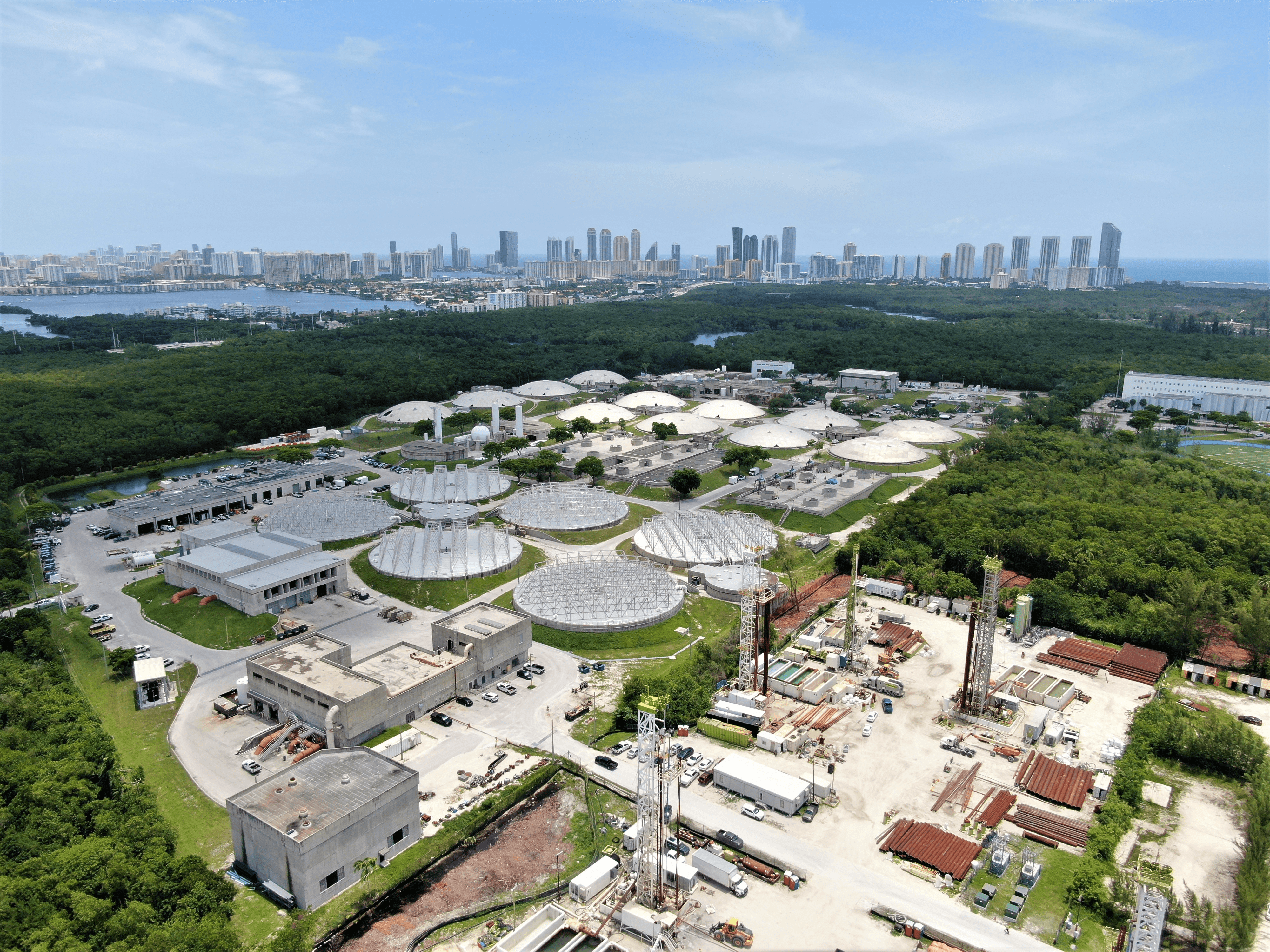
The Ocean Outfall Legislation program carries its own hard deadline. Southeast Florida utilities were legally required to eliminate normal use of ocean outfalls — the practice of discharging treated wastewater directly into the Atlantic — by the end of 2025. Compliance requires not just shutting off the outfall, but building the alternative: expanded reclaimed water reuse systems, enhanced treatment capacity, and the transmission infrastructure to route effluent to beneficial uses rather than the ocean. These are large, complex capital projects that cannot be accelerated simply by adding budget.
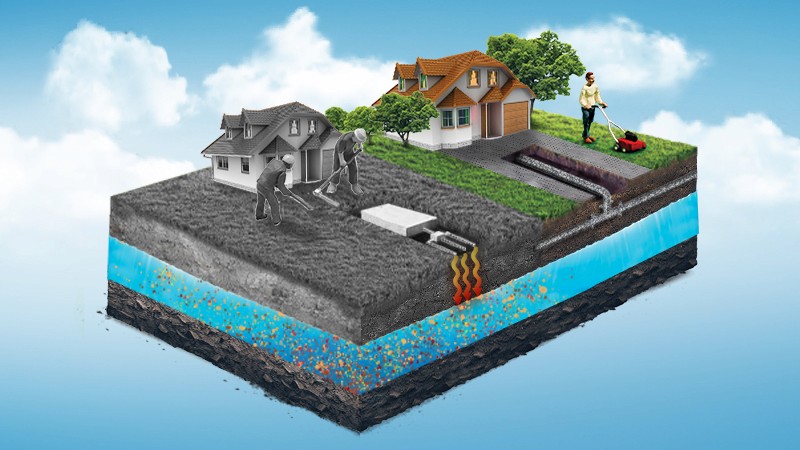
The Connect 2 Protect septic-to-sewer program is in some respects the most operationally demanding of the five. Converting individual residential septic systems to public sewer service requires working property-by-property across thousands of residential lots — coordinating right-of-entry agreements, routing new sewer laterals through established neighborhoods, navigating mature landscaping and driveways, and managing the community relations dimension of a program that directly disrupts daily life for every household it touches. The engineering unit cost per connection is relatively modest. The program management complexity per connection is not.
The Real Bottlenecks: Where Execution Risk Lives
Every large infrastructure program has a public narrative and an engineering reality. The public narrative for the WASD CIP emphasizes economic output, job creation, and the long-term sustainability benefits of modernized infrastructure. The engineering reality is a set of hard constraints that will determine whether this program delivers on schedule, over schedule, or — in the worst case — in partial compliance with the consent decree milestones that trigger federal scrutiny.
Constraint #1: The Qualified Labor Shortage Is Structural, Not Cyclical
South Florida does not have a deep bench of experienced underground utility contractors capable of operating at the speed and quality level this program demands. Pipe rehabilitation, large-diameter sewer replacement, and force main installation in a densely urbanized, traffic-critical environment requires a specific combination of equipment, supervision, and field expertise that cannot be manufactured quickly. The program's own projection of 17,000 new jobs over ten years implicitly acknowledges this gap — but job creation projections describe an outcome, not a plan. The actual sequencing of work must account for the reality that contractor capacity in this market is a finite resource, and the WASD CIP is competing for it against FDOT, Miami-Dade county roadwork, private development, and every other large infrastructure program active in South Florida simultaneously.
Constraint #2: Simultaneous Excavation in a Living Urban System
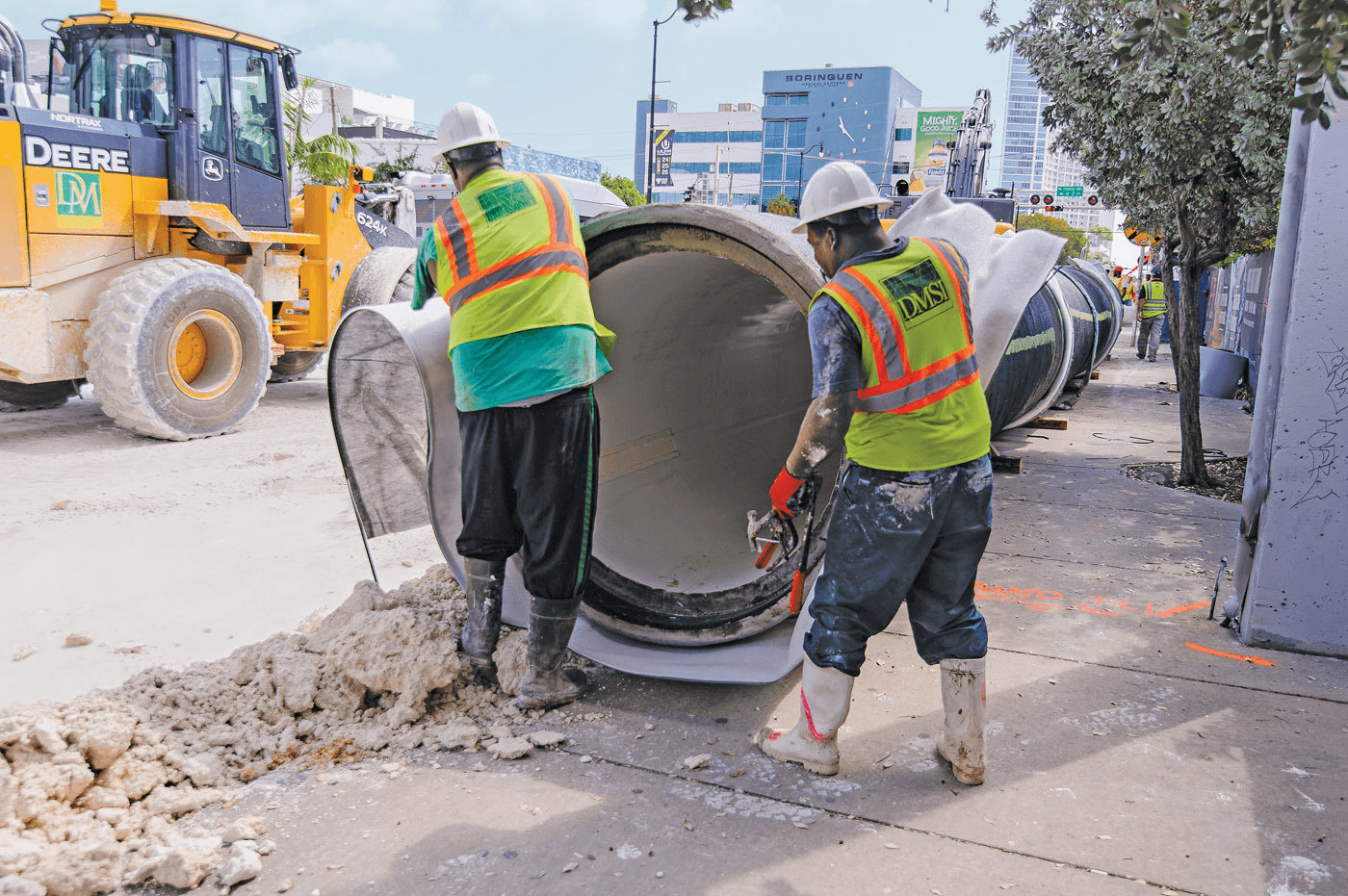
Miami-Dade's urbanized areas contain a subsurface environment of extraordinary density and complexity — water mains, force mains, gas lines, FPL duct banks, AT&T conduit, stormwater culverts, and decades of undocumented utility crossings all occupy the same narrow right-of-way that new sewer infrastructure must navigate. The shallow water table means that virtually any excavation below four feet requires dewatering. The Miami Limestone formation means that rock is frequently encountered at depths where contractors budgeted for soil. Each of these conditions — individually manageable — becomes a compounding schedule risk when they co-occur on a project operating under consent decree milestone pressure.
Constraint #3: Treatment Plant Capacity Cannot Be Taken Offline
Upgrading treatment facilities — whether for nutrient removal, PFAS emerging contaminant control, or reuse expansion — must be accomplished while the plant continues to treat incoming flow, 24 hours a day, 365 days a year. There is no planned downtime in wastewater treatment. This "live system" constraint drives a construction sequencing discipline that adds cost, extends schedules, and demands a level of construction phase planning that distinguishes experienced utility contractors from general civil firms attempting to enter the space.
Constraint #4: Permitting Complexity Across Multiple Jurisdictions
The CIP does not operate in a single regulatory environment. Projects cross municipal boundaries, require SFWMD environmental resource permits for work near wetlands and surface waters, involve FDOT right-of-way encroachment permits on state roads, and in the case of ocean outfall elimination, require FDEP coordination at the state level. Each permit has its own timeline, its own technical submission requirements, and its own agency review capacity — which is also constrained. A project that is shovel-ready from an engineering standpoint can sit for six to fourteen months in a permitting queue that the CIP program office cannot accelerate unilaterally.
The PFAS Problem Deserves Its Own Conversation
The Water Infrastructure Renewal Program's mandate to address emerging contaminants — specifically per- and polyfluoroalkyl substances, universally known as PFAS — represents a dimension of the CIP that is technically distinct from the aging infrastructure programs and operationally more uncertain. PFAS are a class of thousands of synthetic compounds that were used extensively in firefighting foams, industrial coatings, and consumer products for decades. They do not break down in the environment, they accumulate in human tissue, and they have been detected in drinking water supplies across the country at concentrations that the EPA has now established extremely low maximum contaminant levels for.
The challenge for WASD — and for every large drinking water utility in the country — is that the treatment technology for PFAS at scale is still maturing. Granular activated carbon filtration and high-pressure membrane systems (nanofiltration and reverse osmosis) are the currently accepted approaches, but both impose significant capital cost, operating cost, and brine disposal challenges. For a system serving 2.4 million people, the scale of that treatment infrastructure commitment is substantial — and it is being designed against a regulatory framework that the EPA is still actively developing. Engineers and program managers working this problem are, in a real sense, building the plane while flying it.
Where Technology and Innovation Can Change the Execution Equation
The honest assessment of the WASD CIP's execution challenges is not pessimistic — it is a precondition for identifying where technology and process innovation can meaningfully compress timelines, reduce cost, and manage the compounding risk conditions described above. Several specific tools and approaches are worth examining seriously.
Innovation #1: Trenchless Rehabilitation at Scale
Cured-in-place pipe lining (CIPP), pipe bursting, and spiral-wound lining technologies allow existing sewer and water mains to be rehabilitated from inside the pipe — without open-cut excavation. In Miami-Dade's dense urban corridors, where open-cut work triggers traffic management costs, utility conflict risk, and community impact, trenchless methods can reduce per-linear-foot costs by 30–50% while compressing schedules significantly. The CIP's pipe rehabilitation programs are natural candidates for trenchless delivery, and the contractors who have invested in this capability will have a structural advantage in the bid environment.
Innovation #2: Digital Twin Modeling for System Operations
A hydraulic digital twin of the WASD collection and distribution system — a real-time computational model that mirrors actual system behavior — enables operators to simulate the impact of infrastructure improvements before they are built, optimize pump station scheduling to reduce energy costs and overflow risk, and identify the highest-priority rehabilitation candidates within the existing pipe inventory. Several large utilities have deployed digital twin platforms to prioritize capital investment and reduce reactive emergency repair costs. At WASD's scale, the return on that modeling investment is compounding: every dollar of capital deployed to the highest-priority asset delivers more risk reduction than a dollar deployed to a lower-priority asset that fails later anyway.

Innovation #3: Advanced Metering Infrastructure (AMI)
AMI — smart meter networks that provide real-time consumption data and automated leak detection — addresses one of the largest non-revenue water loss problems in aging distribution systems. Unaccounted-for water loss in systems with aging infrastructure routinely runs 15–25% of total production volume. At WASD's scale, each percentage point of loss reduction translates to meaningful treatment and pumping cost savings, and AMI provides the data infrastructure to drive that improvement systematically rather than through periodic manual surveys.
Innovation #4: Nutrient Recovery and Resource Extraction
The Ocean Outfall Legislation's nutrient reduction mandate creates an engineering problem that advanced treatment technology can turn into an asset. Struvite crystallization systems recover phosphorus from wastewater sludge as a slow-release fertilizer product — converting a waste stream into a revenue stream while simultaneously reducing the nutrient loading that drives the outfall compliance obligation. Thermal hydrolysis and anaerobic digestion optimization at treatment plants can recover sufficient biogas to materially offset plant energy costs. These are not experimental technologies — they are in operation at peer utilities. They require capital investment and operational expertise, but they change the long-term cost structure of the system.
Innovation #5: Modular Treatment Plant Construction
Traditional treatment plant expansion follows a design-bid-build procurement model that routinely takes five to eight years from program initiation to operational capacity. Modular and prefabricated treatment systems — particularly for advanced treatment processes like membrane bioreactors and PFAS removal — can compress that timeline to two to three years by shifting fabrication work to controlled factory environments and reducing field construction complexity. For a program operating under consent decree milestones, that schedule compression is not a marginal improvement — it can be the difference between compliance and enforcement action.
Innovation #6: Integrated Permit Coordination Platforms
The multi-jurisdictional permitting complexity described above is a coordination problem as much as a technical one. Program-level permit coordination platforms — which track submission status, agency comment cycles, and resubmittal deadlines across dozens of concurrent permit applications — reduce the administrative latency that consistently adds months to project delivery. On a program with hundreds of active projects across multiple agencies, the cumulative schedule impact of disciplined permit tracking is measurable in program-level delivery acceleration.
The Program Management Architecture Matters as Much as the Engineering
The final and perhaps most underappreciated execution risk in the WASD CIP is organizational, not technical. A program of this scale — hundreds of concurrent projects, five overlapping regulatory programs, dozens of prime contractors and subconsultants, and a 20-year delivery horizon — does not succeed or fail primarily because of engineering quality. It succeeds or fails based on the program management infrastructure that coordinates all of those moving parts against a single set of milestones and a single set of regulatory obligations.
The utilities that have delivered programs of comparable scale and complexity — Los Angeles County Sanitation Districts, Chicago's Metropolitan Water Reclamation District, New York City DEP — have all invested heavily in program-level management systems that operate independently of any individual project's design or construction team. Integrated cost and schedule tracking, earned value management against consent decree milestones, and a disciplined change order management culture are not administrative preferences — they are the organizational technology that determines whether a $10 billion program delivers at $10 billion or at $14 billion.
Miami-Dade has the engineering talent, the regulatory framework, and the funding mechanisms to execute this program successfully. What it requires — from its program management teams, its consultants, and its contractors — is the discipline to treat execution risk as seriously as it treats engineering design. Those are different skills, and the organizations that bring both to this program will define what Miami-Dade's water and sewer infrastructure looks like for the next fifty years.
ASOM's Advantage
Engineering Capacity for the CIP Generation
ASOM understands this program from the ground up — literally. We work in Miami-Dade's right-of-ways, we know its subsurface conditions, and we know what responsible civil design looks like in a system where the water table, the limestone, and the consent decree calendar are all working against you simultaneously.
We provide civil engineering, utility coordination, site design, and construction administration services for water and sewer infrastructure projects across South Florida — for WASD prime consultants, for municipalities coordinating CIP-adjacent infrastructure, and for private developers whose site utility connections depend on the capacity improvements this program is delivering. If the WASD CIP is the backbone of Miami-Dade's infrastructure future, we are the team that works at its joints.